Integration-first builds
USPS, Sage Intacct, Stripe, 360 SMS, FormTitan. OAuth 2.0, idempotent webhooks, Apex REST services, and Named-Credential-driven config that stays clean under load.
Beksultan Islanbek is a certified Salesforce Developer with expertise in Nonprofit Cloud, Service Cloud, Sales Cloud and Experience Cloud, based in San Jose, CA. Five years building production Salesforce — three at enterprise logistics scale (XPO Logistics, Space X Carriers), now applying that rigor to nonprofit work: enrollment platforms, OmniStudio applications, Apex automations, Lightning Web Components, and integrations (USPS, Sage Intacct, Stripe, 360 SMS App). Currently engineering a child enrollment platform at a Bay Area early-childhood nonprofit serving thousands of families.
I specialize in the parts of Salesforce nonprofit work that other developers shy away from: integration-heavy builds, Person Account–centered data models, Experience Cloud kiosks, and OmniStudio applications that have to run reliably for staff who aren't technical. My current platform processes 5,000+ attendance records weekly across 50+ classrooms with 98% first-pass UAT success on production deployments.
I architected and migrated the attendance pipeline from Flow-based automation to Batch Apex + Queueable + Schedulable — 10× faster processing with full governor-limit compliance — and reduced OmniScript page load times by 60%. On the integration side I built USPS address validation (OAuth 2.0 client credentials, ZIP+4 lookup via Queueable callouts), an inbound @RestResource Apex service that produces the daily ADE Matrix for Sage Intacct, Stripe enrollment payments, a FormTitan-powered parent billing portal, and 360 SMS App for parent communications.
The throughline: every system I ship is meant to give time back to mission-driven teams — staff hours that go back to program delivery instead of data entry.
USPS, Sage Intacct, Stripe, 360 SMS, FormTitan. OAuth 2.0, idempotent webhooks, Apex REST services, and Named-Credential-driven config that stays clean under load.
Nonprofit Cloud's modern data model — contact-first design, household-aware sharing, custom Apex sharing for staff access by Center Director, and clean migration paths from NPSP without breaking historical data.
OmniScripts, FlexCards, Integration Procedures, DataRaptors. Production-grade flows for staff who aren't technical — and 60% faster than what they had before.
Over 85% Apex unit test coverage — the foundation under 98% first-pass UAT on production deploys. Governor-limit-compliant Batch Apex, ApexDoc on shared classes, hardened security model (35 Profiles, 30 Permission Sets, 200+ Sharing Rules), and CI/CD via SFDX.
Three years at enterprise logistics scale (XPO Logistics, Space X Carriers), now applying that rigor to mission-driven nonprofit work. The integration patterns, governor-limit discipline, and bulk-safe Apex carry over directly — only the domain changes.
@RestResource Apex with strict JSON deserialization, Stripe enrollment payments + invoice/payment sync, and 360 SMS App for parent communications with opt-in consent tracking.End-to-end family enrollment application built on OmniScripts, FlexCards, Integration Procedures, and DataRaptors. Dependency picklist logic and tuned SOQL patterns reduced page load times by 60%. PIN-based kiosk login and signature capture for 50+ classrooms via Experience Cloud + custom LWCs. On submission, the OmniScript auto-generates a raw-data PDF of the parent's initial application responses, archived as the compliance baseline for the family record.
Custom Apex callout layer for the USPS Developer API. OAuth 2.0 client credentials flow with token caching, credentials stored in Custom Metadata, and asynchronous Queueable callouts to retrieve full ZIP+4 codes during family enrollment. Bulk-updates Account and PartyRelationshipGroup records.
Inbound @RestResource Apex web service exposing the daily Average Daily Enrollment Matrix to Sage Intacct. Strict JSON deserialization, payload validation router, structured error responses, and aggregate SOQL on Attendance__c grouped by Program and Classroom for accurate financial reporting.
Parent SMS notifications via 360 SMS App (Salesforce-native AppExchange). Apex-invocable methods + Flow-triggered SMS templates automate enrollment status updates, document/payment reminders, and classroom/appointment reminders. Built-in opt-in consent tracking.
Migrated a Flow-based attendance system to Batch Apex with self-chaining + Queueable + Schedulable interfaces. Processes 5,000+ attendance records weekly across multiple classrooms while maintaining governor-limit compliance — 10× faster than the legacy Flow system.
Stripe API integration to process enrollment payments and sync invoice/payment statuses with a custom FormTitan-powered Billing Portal for parents. Reconciles Stripe events to Salesforce records with idempotency-safe webhooks.
Two production Visualforce PDF generators for California child-care subsidy compliance — Form 9600 and Notice of Action (NOA). Each pulls family demographics, eligibility flags, and child enrollment schedules into a single audit-ready document, with built-in support for state regulatory variants (CDE and CDSS). Triggered from a record button or a Flow, and saved directly to the family's record in Salesforce for downstream review.
Hardened declarative security across Nonprofit Cloud + Person Account — 35 Profiles, 30 Permission Sets, 20 Permission Set Groups, a 13-role hierarchy, and 200+ Sharing Rules layered over locked-down Organization-Wide Defaults. Granular FLS/CRUD controls scope family records, enrollment data, and PII to staff who actually need it across program areas — durable enough to survive role changes and re-orgs.
Custom Apex sharing layer that grants Center Directors and assigned staff exactly the access they need based on the Staff Assignment chain — Center → Classroom → Schedule → Child → Parent/Guardian. Cascades programmatic AccountShare and ContactShare records (Edit access on child accounts for attendance and immunization, Read-only on parents and centers) so permissions update automatically as staff are assigned or reassigned, without manual access tickets.
Custom Lightning Web Component (the "Schedule Board") that replaces a multi-step weekly time-entry workflow with a single grid. Reactive state for instant feedback, bulk-safe Apex on save, and a Paste M-F UX pattern that copies one row to all five weekdays. Dual Regular and School-Age schedule sections live side-by-side on one screen, with live Contracted Hours totals that catch entry errors before commit. Cut weekly scheduling time by 70% across 50+ classrooms — staff hours that go back to program delivery.
Detailed system documentation maintained alongside the platform — Salesforce architecture, entity relationships, automation workflows, batch and scheduling designs, sharing-model enhancements, dependency maps, environment trackers, per-release changelogs, an incident log, and a rollback playbook. ApexDoc on shared classes. Goal: any future admin, developer, or auditor can navigate the system end-to-end with no dependency on me.
Selected screenshots from production Salesforce builds — the actual UI staff use every day, not mockups. This library will grow as more shippable artifacts come online.
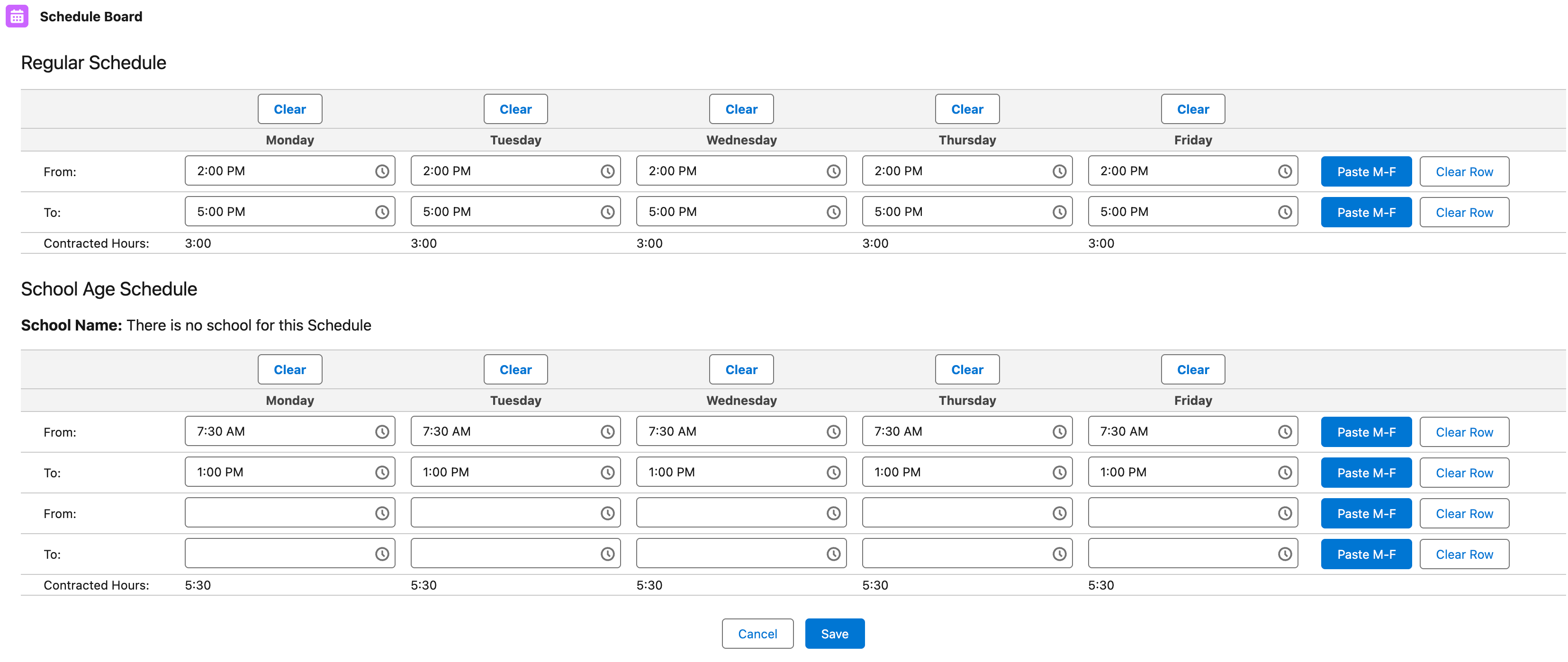
Replaces a multi-step weekly scheduling process with a single grid. Paste M-F bulk-fills 5 days from one row; live Contracted Hours totals catch entry errors before save; dual Regular and School-Age sections on one screen so staff don't navigate between records. Cut weekly scheduling time by 70% across 50+ classrooms.
A Salesforce nonprofit developer customizes Salesforce Nonprofit Cloud (or NPSP) so it fits the way your organization actually operates — building Apex automations, Lightning Web Components, OmniStudio screens, Experience Cloud portals, and integrations to systems like accounting software (Sage Intacct, QuickBooks), payments (Stripe), SMS (360 SMS, Twilio), and address verification (USPS). The goal is fewer manual handoffs, cleaner data, and tools that case workers, intake teams, and donors can actually use.
NPSP (Nonprofit Success Pack) is the older managed-package model built on top of Sales Cloud, mostly oriented around fundraising and donor management. Nonprofit Cloud is Salesforce's modern Industry-Cloud-style product built on the Person Account framework with native Program Management, Case Management, and Outcome Management. New Salesforce nonprofit implementations in 2025+ should target Nonprofit Cloud unless there's a strong reason to stay on NPSP.
A targeted build (single program area, one or two integrations, basic reports) typically runs 6–10 weeks. A full intake-to-outcome platform with Experience Cloud, multiple integrations, role-based security, and analytics usually runs 4–6 months. Quick-win automations (a single Flow, an LWC, an integration touch-up) can often be delivered in 1–2 weeks.
Recently: USPS Address API (OAuth 2.0 client credentials, ZIP+4 lookup via Queueable Apex), Sage Intacct (inbound Apex REST service producing the daily Average Daily Enrollment Matrix), Stripe (enrollment payments + invoice/payment status sync), FormTitan (custom parent billing portal), and 360 SMS App (parent communications, enrollment reminders, classroom reminders via Apex-invocable methods and Flow-triggered SMS templates).
Yes. Based in San Jose, CA but engagements run remotely across the US. Bay Area nonprofits get the option of occasional onsite working sessions.
Reach out by email or LinkedIn — happy to discuss scoped contract engagements, short discovery audits, or longer fractional development arrangements with mission-driven organizations.
Yes — every build runs through a multi-agent pipeline with specialized Design, Developer, Admin, and DevOps sub-agents, plus automated /code-review and /sf-security commands on every change. AI augments the rigor, it doesn't replace it: a human Salesforce developer with five years of platform experience approves every design, reviews every diff, and owns every deploy. Apex test coverage stays well above the 85%, security review runs against the OWASP Top 10 and Salesforce-specific risks like SOQL injection, CRUD/FLS bypass, and sharing-rule gaps, and nothing reaches a sandbox without passing the full quality gate. Net effect: faster cycle time, more documentation, fewer regressions — without trading away the safety nets nonprofits rely on.
Happy to jump on a 15-minute technical health-check call to walk through your current Salesforce roadblocks — no strings attached. Whether you need a custom LWC to free up staff time or a full Nonprofit Cloud migration, the goal is to build something that lasts. Based in San Jose; in-person coffee in the Bay Area or remote nationwide. I usually reply to email within a business day.